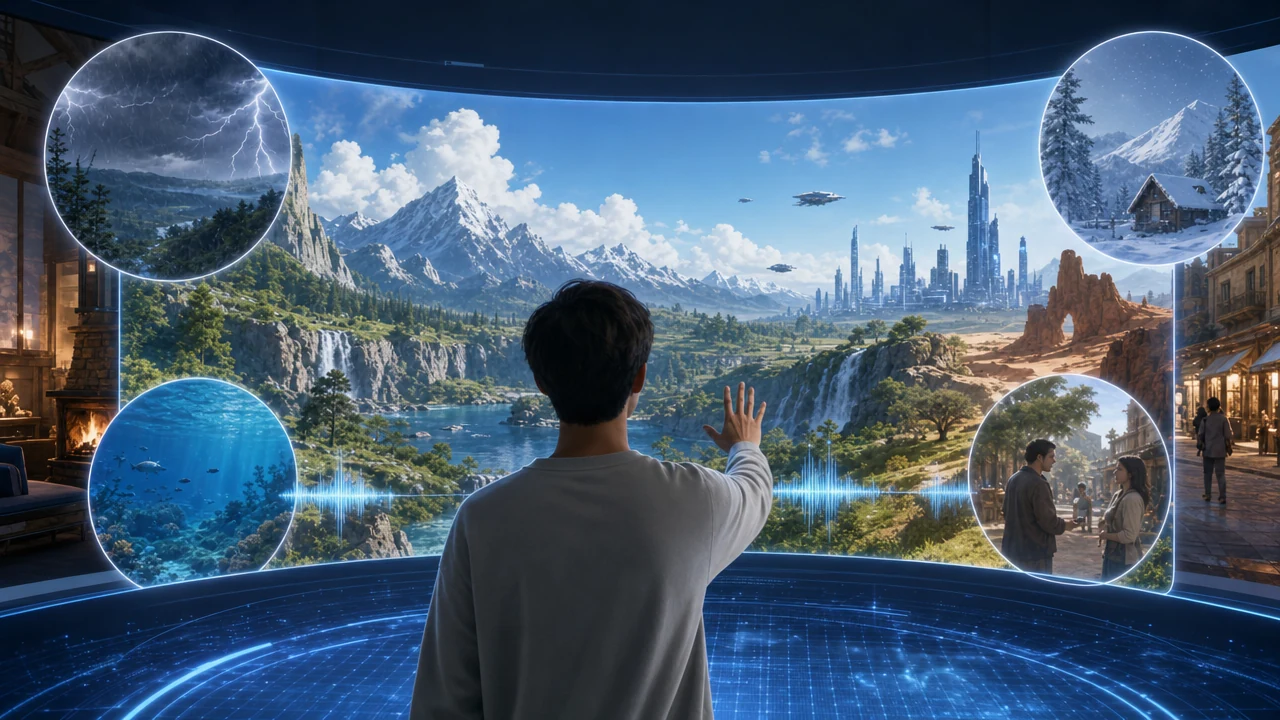
On October 27, 2026, Google DeepMind officially announced its research on Genie 4, the laboratory's newest world model built for real-time interactive simulation.
According to Google, Genie 4 introduces "unprecedented realism" alongside native audio generation, while media reports note that single simulation sessions can now run for up to roughly two minutes—double the upper limit of its predecessor, Genie 3.
Before you rush to try it out, however, it is worth clarifying the nature of this release. Google's official phrasing is "announcing our research on Genie 4." Rather than a wide, free-for-all commercial launch, the model is currently beginning a phased rollout to a small cohort of trusted testers, with broader access slated for select subscription and developer channels in the near future.
Even with limited initial availability, Genie 4 marks a pivotal moment in generative AI. Here is a closer look at what Genie 4 brings to the table, how the Genie series has evolved over just four generations, and where the technology still hits a wall.
1. What Is Genie 4, and Why Is Google Obsessed with "World Models"?
Over the past two years, video generation models have taught AI how to produce compelling moving images. Yet a generated video remains a passive experience: once the prompt is processed, the viewer can only watch the footage play out linearly.
World models operate on a fundamentally different premise. As defined by Google DeepMind, a world model is an AI system that uses its understanding of the world to simulate aspects of it, enabling an agent to predict both how an environment will evolve and how its own actions will affect that environment.
The team behind Google's Project Genie frames this as a paradigm shift from passive video generation to interactive media. Instead of merely watching a rendered clip, a user—or an AI agent—can step inside the generated frame and interact with it in real time.
For DeepMind, this is not a sudden pivot. It builds on more than a decade of research into simulated environments, ranging from training agents in real-time strategy games to open-ended learning and robotics simulations. Google explicitly positions simulating the world as a critical step toward Artificial General Intelligence (AGI) for two primary reasons:
- Safe Training Grounds for Agents: World models provide safe, limitless training environments for robotics and autonomous AI agents before they ever touch the physical world.
- Next-Generation Creative Tools: They supercharge creative workflows across industries including filmmaking, journalism, gaming, and manufacturing.
2. Four Generations in Two Years: The Evolution from Genie 1 to Genie 4
The pace at which the Genie family has matured highlights how quickly spatiotemporal modeling is advancing. In less than three years, the project has progressed from choppy 2D frames to audio-equipped, photorealistic simulations.
| Generation | Release Date | Key Capabilities & Specifications |
|---|---|---|
| Genie 1 | March 2024 | First generative interactive environment trained unsupervised on unlabeled internet videos; 11B parameters; supported text, synthetic images, photos, and sketch prompts; limited to 2D environments at roughly 1 frame per second (1fps). |
| Genie 2 | 2024 | Stepped up to richly detailed interactive 3D worlds; responded realistically to actions like jumping, swimming, and moving objects; maintained a visual memory of roughly 10 seconds. |
| Genie 3 | August 5, 2025 | General-purpose world model; real-time interaction at 720p and 24fps; extended visual memory to the minute-level scale; introduced promptable world events; released as a limited research preview. |
| Genie 4 | October 27, 2026 | Introduces native audio generation; extends simulation length to roughly 2 minutes (double Genie 3's cap); delivers "unprecedented realism"; rolling out via trusted testers, Google AI Ultra, and API channels. |
1. Genie 1 (March 2024): Learning to Be Controlled from Unlabeled Video
Genie 1 proved a foundational concept: an 11-billion-parameter model could watch massive amounts of unlabeled internet video and learn, entirely unsupervised, not just what scenes look like, but how they become interactive. Users could prompt it with text, photos, or even hand-drawn sketches. However, it was restricted to 2D side-scrolling-style environments and ran at a sluggish 1fps.
2. Genie 2 (2024): Entering Interactive 3D Worlds
Later in 2024, Genie 2 broke out of the flat plane to generate detailed, interactive 3D environments. It could react believably to actions like jumping, swimming, or interacting with objects, while remembering parts of the environment that went off-screen for about 10 seconds.
3. Genie 3 (August 2025): Real-Time Interaction and Physics
Genie 3 merged the spatial progress of Genie 2 with the capabilities of Veo 3, Google's video generation model known for its grasp of physics and object interactions. Running in real time at 720p resolution and 24 frames per second, Genie 3 expanded visual memory from seconds to minutes and allowed users to trigger "promptable world events" mid-simulation.
4. Genie 4 (October 2026): Audiovisual Cohesion and Doubled Duration
Now, Genie 4 bridges the sensory gap by adding native audio and pushing simulation endurance up to roughly two minutes—prompting media outlets like Quartz to call it "its most realistic AI world model yet."
3. Deconstructing Genie 4: Core Upgrades and Underlying Mechanics
1. The Three Confirmed Breakthroughs in Genie 4
Based on Google's official research announcement and initial reporting, Genie 4's advancements center on three pillars:
- Native Audio Generation: Earlier iterations of Genie produced silent worlds. Genie 4 generates native audio directly alongside the real-time visual simulation, dramatically increasing environmental immersion.
- Doubled Simulation Duration (~2 Minutes): According to Quartz, Genie 4 can sustain a single simulation for up to two minutes, which is twice the upper limit of Genie 3. (Note: Past documentation and coverage of Genie 3 have varied slightly, describing its memory and duration limits anywhere from "about one minute" to "multiple minutes," but Genie 4's two-minute benchmark represents a clear leap in sustained coherence.)
- Unprecedented Realism: DeepMind emphasizes a sharp uptick in visual fidelity and realistic environmental feedback during real-time interaction.
2. Under the Hood: How the Genie Architecture and Project Genie Work
Note: Because Google has only released a high-level research announcement for Genie 4, the following architectural and workflow details draw from the established foundations of Genie 1–3 and the Project Genie prototype interface.
At a foundational level, the Genie family belongs to the class of spatiotemporal Transformers, which model both the contents of each individual frame and how scenes evolve over time. As detailed in the original Genie 1 research, the core architecture relies on three components: a spatiotemporal video tokenizer, an autoregressive dynamics model, and a scalable latent action model. Crucially, the latent action model infers controllable actions between frames without requiring ground-truth action labels or controller inputs in the training data.
On the product side, users interact with these models through Project Genie, an experimental research prototype that pairs Gemini (for prompt comprehension) with the Genie world model (for world generation):
- Multimodal World Building: Users can create worlds and characters using text descriptions alongside uploaded or AI-generated images, and define traversal modes such as walking, riding, flying, or driving.
- World Sketching: Integrated with Nano Banana Pro, the World Sketching feature lets users preview and modify the generated image before stepping into the simulation, as well as choose between first-person and third-person camera perspectives.
- Real-Time Controls and Remixing: Once inside, the model generates the path ahead on the fly as the user navigates via standard keyboard controls (
WASDto move, arrow keys to pan the camera, and the spacebar to ascend). The platform also supports world remixing and integrates with Google Street View.
3. Unconfirmed Specs: What Google Has Not Disclosed Yet
In keeping with rigorous reporting, it is important to point out what remains unknown. In its October 27 announcement, Google did not disclose Genie 4's exact output resolution, frame rate, parameter count, specific architectural changes, or whether it retains or expands upon Genie 3's promptable world events. While Genie 3 operated at 720p and 24fps, those figures should not be automatically assumed as Genie 4's ceiling until Google publishes formal technical specifications or a research paper.
4. Real-World Applications: Far More Than "AI Game Making"
When people see a controllable virtual environment, their immediate thought is video games. While gaming is a major piece of the puzzle, DeepMind's roadmap targets a much broader industrial footprint.
1. Game Prototyping and Interactive Entertainment
In tests of Project Genie, users and journalists have used simple prompts to spin up physics-aware environments, expressive characters, and playable "mini-games"—including homages reminiscent of The Legend of Zelda or Super Mario.
Industry observers note that tools like Genie could eventually allow players to build bespoke worlds tailored to their personal tastes, potentially birthing entirely new gaming genres. The traditional gaming market has certainly taken notice: following previous Genie announcements, shares of several major video game companies saw noticeable dips.
2. Robotics and Embodied AI Training
Training a physical robot in the real world is slow, expensive, and prone to hardware damage. World models offer an "infinite training space" where embodied AI agents can learn safely.
For instance, researchers can simulate complex, high-risk edge cases—such as an autonomous vehicle navigating severe weather or a wingsuit flyer gliding through mountain terrain—and use promptable world events to test how an agent reacts to sudden, unexpected disruptions.
3. Filmmaking, Content Creation, and Education
Google specifically highlights filmmaking, journalism, and manufacturing as target beneficiaries of Genie 4. Directors and animators can rapidly prototype fantastical sets, pre-visualize camera angles, or test expressive animated characters in interactive spaces. In education, teachers can bring history or science to life by letting students actively explore reconstructions of ancient cities or outer space right from the classroom.
5. A Sober Assessment: Current Limitations and How to Get Access
Despite the impressive demos, world models are still in their infancy. For developers and creators evaluating Genie 4, four practical limitations stand out:
1. Frame-by-Frame 2D Rendering, Not Exportable 3D Assets
Judging by the architecture established through Genie 3, these models generate a 2D rendering of a 3D-like environment frame by frame. Unlike Unreal Engine or Unity, Genie is not a 3D modeling tool—you cannot simply export a polygonal mesh, texture map, or rigging asset into a traditional game production pipeline.
2. World Consistency and Long-Term Memory Remain Hard Problems
Even with simulation length doubling to two minutes, maintaining strict spatial and physical consistency over time—making sure a room looks the exact same when you turn around two minutes later—remains what the Project Genie team calls a core technical challenge.
3. Research Prototype Status
As tech reviewers observed during the Genie 3 rollout, Project Genie is fundamentally a research project: it is fascinating to play around in, "but doesn't really do anything on its own." Bridging the gap between a two-minute interactive sandbox and a full-scale commercial product will require significant engineering.
4. Missing Technical Documentation
While the original Genie 1 was accompanied by a detailed arXiv paper, Genie 3's formal technical report remained listed as "coming soon" after its debut, and Google's Genie 4 announcement similarly arrived without an attached academic paper.
How Can Developers and Creators Try Genie 4?
Google is rolling out Genie 4 across three distinct tiers:
- Trusted Testers: Rollout has already begun for a small group of trusted testers to gather safety and usability feedback.
- Google AI Ultra Subscribers: Genie 4 will be available "soon" to Google AI Ultra subscribers via Project Genie (during the Genie 3 cycle, access was offered to U.S.-based Ultra subscribers aged 18+ at
labs.google/projectgenie). - Developers and Enterprise Partners: Early access partners will be able to experiment with Genie 4 through the Gemini API and Google AI Studio.
- General Public: Anyone can currently view the official Genie 4 demonstrations on the Google DeepMind blog.
Conclusion
With the addition of native audio, a two-minute simulation window, and heightened visual realism, Genie 4 proves that AI is steadily moving past the era of generating static text and linear video clips. We are witnessing the early days of generative, multimodal, interactive worlds.
Critical questions around 3D asset interoperability, long-term spatial memory, and compute costs remain unanswered. Yet by bringing Genie 4 into the Gemini API and Google AI Studio alongside Project Genie, Google DeepMind is signaling that world models are ready to graduate from isolated lab demos into the broader developer ecosystem. For anyone building in gaming, digital media, or embodied AI, that transition is well worth watching.