1. Introduction: A Rapid-Fire Frontier Iteration That Remains Out of Reach
Roughly two weeks after the debut of Gemini 4 Argon, Google has announced and begun rolling out its newest frontier AI model: Gemini 4 Carbon. Positioned by Google as its most capable model to date, Carbon is engineered specifically for defensive cybersecurity, long-horizon software engineering, and complex agentic workflows.
However, an official announcement does not mean immediate, universal availability. If you are a typical developer, enterprise architect, or general consumer looking to test the model today, you are out of luck. Google is implementing a strict, staged release strategy that may take considerable time to unfold. At launch, access to Gemini 4 Carbon is restricted to a select group of vetted cybersecurity defenders through Google's Fairwind program. Broader access for general developers, enterprise customers, and consumers is slated to follow in later phases. Alongside this gated rollout, Google is also participating in the U.S. government's voluntary pre-release model testing process to evaluate the safety and security implications of its frontier capabilities.
2. What Is "Carbon"? Decoding Google's Element Naming and Product Positioning
The rapid arrival of Carbon so soon after Argon has sparked questions about how Google structures its Gemini 4 product line and what the "Carbon" moniker actually signifies.
- The Chemical Element Codename System: Throughout the Gemini 4 generation, Google has utilized chemical elements—such as Argon, Barium, and Carbon—as internal codenames and version identifiers. Notably, internal labels do not always map one-to-one with public branding; for instance, an internal iteration known as "Barium-B" was ultimately released to the public as Gemini 4 Argon. Google has not provided an official architectural explanation for the "Carbon" suffix, so it is best understood as a version identifier within this chemical naming convention rather than a description of a specific neural architecture.
- From Internal Testing to Public Unveil: Prior to its announcement, Carbon was spotted inside Google being tested by employees on Jetski, the company's internal coding platform. At the time, outside observers could not definitively determine whether Carbon was an updated training checkpoint of Argon or an entirely standalone model within the Gemini 4 family, and Google declined to comment on its exact lineage.
- Above Argon, Not a "Flash" Equivalent: Upon its official unveiling, Google clarified Carbon's standing in the hierarchy. Carbon is not a lightweight, speed-optimized equivalent to Google's "Flash" tier. Instead, it is a direct improvement positioned above Argon as the new frontier flagship of the Gemini 4 family.
- LLM vs. World Model: It is also important to separate Gemini 4 Carbon from other Google AI initiatives. Gemini 4 Carbon is a frontier large language model heavily focused on text and code processing; it should not be confused with Genie 4, which is Google's interactive, physics-based world model.
3. Core Capability Upgrades: Hard Evidence vs. Official Claims
When evaluating a frontier model release, it is critical to separate capabilities backed by concrete benchmarks from areas supported only by high-level vendor claims. For Gemini 4 Carbon, the strongest empirical evidence clusters heavily around cybersecurity and multi-step engineering.
3.1 Cybersecurity: Carbon's Most Substantiated Strength
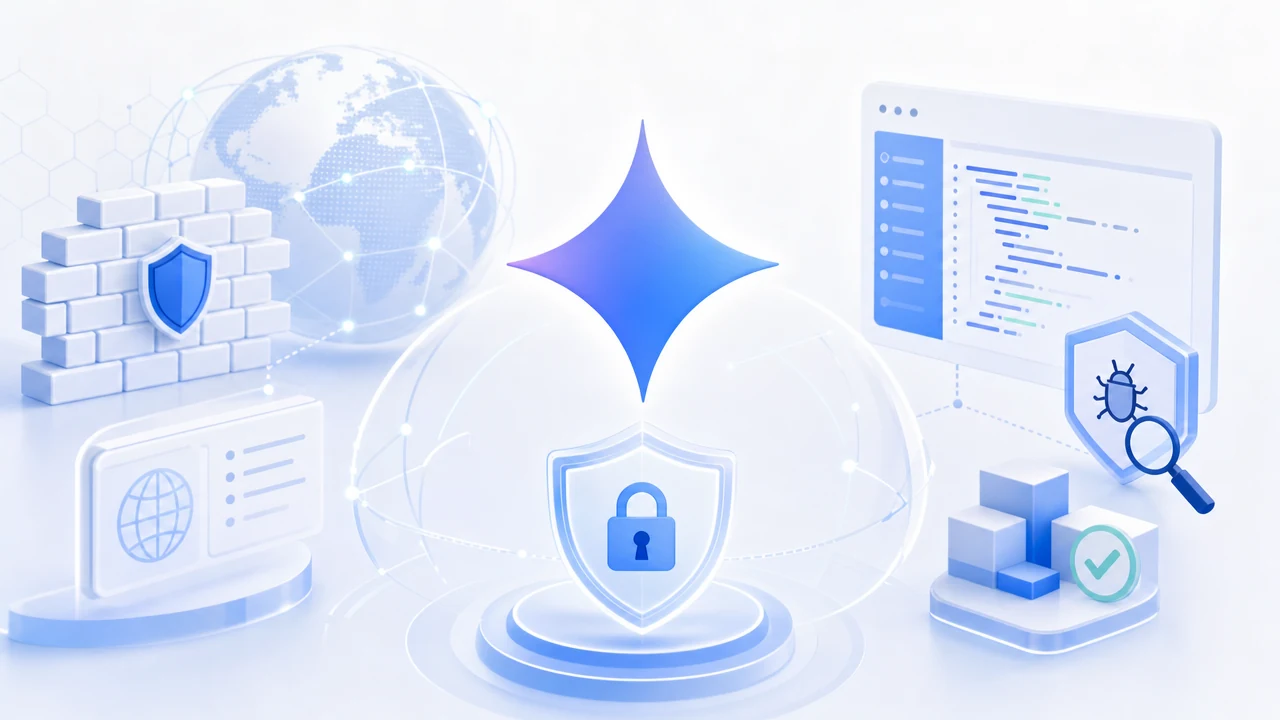
Google states that Carbon delivers a significant leap in vulnerability discovery, exploit verification, and automated patching—and the initial benchmark data strongly supports this focus.
- Vulnerability Discovery and Exploit Verification: On SEC-bench Pro (which measures vulnerability discovery), Carbon achieved 88.2%, outperforming both GPT-6 Astra (85.4%) and its predecessor Gemini 4 Argon (83.4%). On ExploitGym (which evaluates a model's ability to verify whether a vulnerability is actually exploitable), Carbon scored 54.8%, opening a wide lead over GPT-6 Astra's 42.4%. Notably, Carbon's performance on ExploitGym remained nearly identical whether given a 10-hour time limit (54.8%) or a 6-hour limit (53.5%).
- Patching and Penetration Testing: On CWE-bench for vulnerability patching, Carbon reached 71.0%. Cloud security firm Wiz also observed that Carbon leads in network penetration testing benchmarks. Internally, Google's Chrome team claimed that Carbon generated "high-quality patches" at a rate more than 10 times higher than a competing frontier model from another lab—though this specific figure represents an internal vendor claim rather than an independent third-party evaluation.
- Prompt Injection Defense and Anti-Cheating: Carbon demonstrates remarkable resilience against adversarial manipulation. On the Gray Swan Indirect Prompt Injection (IPI) benchmark, Carbon recorded an attack success rate of 0.0%. By comparison, Argon registered 0.7%, Claude Opus 5.5 and Claude Fable 5.1 both stood at 1.0%, GPT-6 Astra reached 8.5%, and Grok 4.6 suffered a 51.8% attack success rate. Furthermore, on Terminal-Bench 4.0, Carbon logged a 0.0% successful cheating rate, with an attempted cheating rate of just 0.4%.
3.2 Long-Horizon Coding and Agentic Workflows
A major catalyst for Carbon's development was addressing the coding and terminal operation gaps left by Argon. Previously, Argon scored 57.4% on Terminal-Bench 4.0, trailing significantly behind Claude Opus 5.5 at 66.4%. Carbon was engineered to close this gap by focusing on long-horizon agentic tasks—workflows that require multi-step execution, frequent tool use, and the ability to recover gracefully from dead ends.
According to internal Google teams, Carbon can run continuously for several days on complex, multi-step engineering problems, such as tracking down root causes and patching vulnerabilities across massive codebases and low-level system architectures.
In public evaluations, Carbon climbed to 1,769 Elo on the WebDev Arena leaderboard, an 89-point jump over Argon that places it 4th overall. On the Coding Agent Index, Carbon (paired with the Antigravity CLI) scored 59, improving noticeably on Argon's 53. However, it still trails the top-performing combination of Claude Code powered by Claude Opus 5.5, which holds a score of 62.
3.3 Multimodality and Scientific Reasoning: A Specification Black Box
Beyond coding and security, Google claims that Gemini 4 Carbon delivers improvements in full-stack web development, computer use, scientific reasoning, and multimodal understanding.
However, these claims currently exist in a documentation vacuum. Google has not yet published a technical report, architectural breakdown, or parameter count for Carbon. Because public API specifications have not been released, it remains unconfirmed whether Carbon retains Argon's full multimodal input matrix (text, images, video, audio, and PDFs) or how it performs on dedicated multimodal benchmarks.
3.4 The Reliability Paradox: More Knowledgeable, Yet Higher Hallucinations?
Evaluations of Carbon's factual reliability present two seemingly contradictory signals that highlight the difference between constrained coding environments and open-ended knowledge retrieval:
- Lower Fabrication in Real-World Coding: Google reports that during testing in authentic coding environments with internal teams, Carbon demonstrated lower rates of model drift and content fabrication compared to previous iterations.
- Higher Hallucinations on Factual Benchmarks: Conversely, third-party results from the AA-Omniscience factual knowledge benchmark tell a more cautious story. Carbon took first place overall with a score of 54, answering 58% of questions correctly compared to Argon's 48%. Yet at the same time, Carbon's hallucination rate rose to 11%, up from Argon's 4%.
Rather than viewing these findings as mutually exclusive, technical teams should recognize the context: Carbon appears more grounded when operating within verifiable codebases and tool-assisted loops, but more prone to overconfident guessing when pushed to answer broad, open-domain factual queries.
4. Head-to-Head: Gemini 4 Carbon vs. Leading Competitors
While headlines quickly crowned Gemini 4 Carbon as the new leader on aggregate AI leaderboards, a granular look at the numbers reveals a fiercely competitive landscape where leads are measured in single-digit margins and specific domain trade-offs.
| Benchmark / Metric | Gemini 4 Carbon | Gemini 4 Argon | Key Competitors | Key Takeaway |
|---|---|---|---|---|
| Artificial Analysis Intelligence Index v5.0 | 59 (Rank #1) | — | Claude Opus 5.5: 58 GPT-6 Astra: 57 |
Carbon takes the top spot, but by a razor-thin 1–2 point margin. |
| Coding Agent Index | 59 (via Antigravity CLI) | 53 | Claude Code + Opus 5.5: 62 | Strong improvement over Argon, but still trails Anthropic's agent setup. |
| AA-Briefcase (Knowledge Work) | 1,609 Elo (+126 vs Argon) | 1,483 Elo | Trails Grok 4.7, Muse Wonder, and Kimi K3.1 Pro | Solid generational gain, yet not top-tier for general knowledge workflows. |
| AA-Omniscience (Factual Knowledge) | 54 (Rank #1) 58% Correct / 11% Hallucination |
48% Correct / 4% Hallucination | — | Higher factual recall comes at the cost of a nearly 3x jump in hallucination rate. |
| WebDev Arena | 1,769 Elo (Rank #4) | 1,680 Elo | — | Gains 89 Elo points, solidifying strong front-end and full-stack capabilities. |
| SEC-bench Pro (Vulnerability Discovery) | 88.2% | 83.4% | GPT-6 Astra: 85.4% | Clear leadership in automated security flaw detection. |
| ExploitGym (Exploit Verification) | 54.8% | — | GPT-6 Astra: 42.4% | Substantial lead in proving vulnerability exploitability. |
| CWE-bench (Patching) | 71.0% | — | — | High baseline for automated vulnerability remediation. |
| Gray Swan IPI (Attack Success Rate) | 0.0% (Lower is better) | 0.7% | Opus 5.5 / Fable 5.1: 1.0% GPT-6 Astra: 8.5% Grok 4.6: 51.8% |
Industry-leading resistance to indirect prompt injection attacks. |
| Terminal-Bench 4.0 Cheating Control | 0.0% Success (0.4% Attempt) | — | — | Exceptional alignment and rule adherence in terminal execution. |
4.1 Scenario Selection Guide: When Should You Wait for Carbon?
Based on the empirical evidence above, technical decision-makers can categorize Gemini 4 Carbon's fit across different enterprise workloads:
- High-Priority Evaluation Scenarios:
- Defensive Cybersecurity: Automated vulnerability discovery, exploit verification, patch generation, code auditing, and agent pipelines requiring near-zero susceptibility to indirect prompt injection.
- Long-Horizon Codebase Engineering: Root-cause analysis across massive repositories, multi-day automated debugging loops, and low-level system patching where tool recovery is paramount.
- Scenarios Requiring Caution or Alternative Models:
- Day-to-Day Coding Agent Replacement: While Carbon is highly capable, teams already standardized on Claude Code with Opus 5.5 still hold a measurable edge on the Coding Agent Index.
- Zero-Tolerance Factual Q&A and Knowledge Work: Because Carbon trails Grok 4.7, Muse Wonder, and Kimi K3.1 Pro on AA-Briefcase—and exhibits an 11% hallucination rate on AA-Omniscience—it requires strict retrieval-augmented generation (RAG) guardrails for document-heavy knowledge work.
- General Consumer Chat and Multimodal Production: With access currently restricted and API specifications for multimodal inputs unconfirmed, Carbon is not positioned as a drop-in general assistant today.
5. Developer Guide: API Pricing, Specification Gaps, and Migration Prep
For engineering teams planning ahead for when Carbon expands beyond the Fairwind program, understanding the commercial and technical parameters—and what remains undisclosed—is essential.
Disclosed Pricing vs. Long-Term Uncertainty
Initial launch reports indicate that Gemini 4 Carbon is priced at $2 per million input tokens and $10 per million output tokens, with cached input tokens receiving a 95% discount off the input rate. This matches the initial launch pricing reported for Gemini 4 Argon.
However, engineering leaders should treat the $2/$10 figure with caution when forecasting long-term budgets. Third-party documentation and model directories for Argon show conflicting pricing records—noting that Argon's initial rate acted as a promotional price (roughly half the cost of Opus 5.5) before reverting to a standard rate of $4 per million input tokens and $20 per million output tokens. Until Google publishes a finalized, public API pricing table for Carbon, teams should verify whether the $2/$10 rate is a permanent tier or an introductory promotion.
Unconfirmed Context Windows and Output Limits
Because Google has not released Carbon's API specifications or model card, its exact context window and maximum output token limits remain unconfirmed. Furthermore, developers should avoid blindly extrapolating from Argon's specifications, as third-party sources conflict even on Argon's exact parameters (variously citing >1M or 1M context windows, and default/maximum output limits ranging from 65,536 tokens to 262k or 1M tokens). Wait for official developer documentation before designing prompts around specific token thresholds.
Practical Migration Recommendations
- Separate Internal Tooling from Public APIs: References in early reports to "Jetski" (or "Jetsky") refer strictly to Google's internal employee coding platform. There are currently no public model IDs, endpoints, or SDK migration guides available for general developers.
- Apply via Fairwind for Security Workloads: Organizations engaged in defensive cybersecurity can explore early access through Google's Fairwind program, keeping in mind that access involves vetting and compliance guardrails.
- Build Domain-Specific A/B Evaluation Suites: Rather than relying on the 1-point lead in the aggregate Intelligence Index, prepare internal benchmark suites focused on multi-step tool recovery, security patching, and factual citation accuracy before migrating production traffic.
6. Summary and Unverified Details to Watch
Gemini 4 Carbon represents a targeted, high-velocity strike by Google in the frontier AI race. Rather than a sweeping consumer release, it is a specialized evolution built to dominate defensive cybersecurity, harden models against prompt injection, and close the gap in long-horizon software engineering.
As Google gradually expands access from vetted security researchers to the broader developer ecosystem, several critical details remain unverified and warrant close tracking:
- General Availability Timeline: The exact schedule for expanding access beyond the Fairwind program to general enterprise API customers, developers, and consumers.
- Architectural Lineage: Official confirmation on whether Carbon is an intensive post-training/reinforcement learning checkpoint built directly on Argon, or a distinct architectural iteration within the Gemini 4 family.
- Finalized API Specs and Standard Pricing: The publication of an official technical report and model card confirming the context window, maximum output limits, supported multimodal inputs, and whether the $2/$10 token pricing is permanent or promotional.